
Silk Mobile
Table of Contents (Homepage)
- Overview
- Setting Up
- Getting Started
- How To
- Connecting Devices And Emulators
- Preparing Applications For Testing
- Managing Applications
- Recording Tests
- Working With Test Commands
- Adding Commands To Your Scripts
- Object Commands
- Click
- ClickCoordinate
- ClickIn
- ClickOffset
- Drag
- ElementGetProperty
- ElementGetTableRowsCount
- ElementListPick
- ElementListSelect
- ElementListVisible
- ElementScrollToTableRow
- ElementSendText
- ElementSetProperty
- ElementSwipe
- ElementSwipeWhileNotFound
- GetAllValues
- GetElementCount
- GetElementCountIn
- GetTextIn
- IsElementBlank
- IsElementFound
- IsFoundIn
- LongClick
- RunNativeAPICall
- SendWhileNotFound
- VerifyElementFound
- VerifyElementNotFound
- VerifyIn
- WaitForElement
- WaitForElementToVanish
- GetCoordinateColor
- DragDrop
- Application Commands
- Device Commands
- Web (Hybrid) Specific Commands
- Utilities Commands
- Monitoring Commands
- Configuration Commands
- ExtractLanguageFiles
- SetDefaultClickDownTime
- SetDefaultTimeOut
- SetDefaultWebView
- SetDragStartDelay
- SetInKeyDelay
- SetKeyToKeyDelay
- SetLanguage
- SetLanguagePropertiesFile
- SetShowImageInReport
- SetShowPassImageInReport
- SetShowReport
- SetSpeed
- SetThrowExceptionOnFail
- SetWebAutoScroll
- StartStepsGroup
- StopStepsGroup
- TextFilter
- Miscellaneous Commands
- Controlling Element Identification Rules
- Editing Test Objects
- Executing Test Scripts
- Report Of Executed Test
- Working From Code Environment
- Continuous Integration
- Layout Verification Tests
- Use Device Vitals Monitors
- Troubleshooting
- Terminology
StartVideoRecord
StartVideoRecord()
|
|
|
|
|
|
|






Description
These commands gives you the ability to video record the test execution, and later view it as part of the generated report .
Parameters
None
Usage
Example:
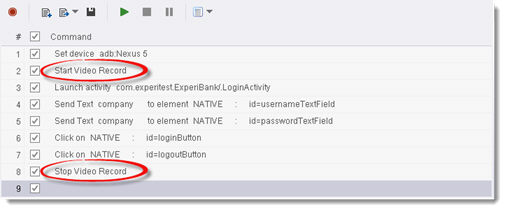
The record will start once the command StartVideoRecord is executed in the script, and will stop when the command StopVideoRecordis called for.
To launch the video, choose the StopVideoRecord command. This step will include the video of the execution.
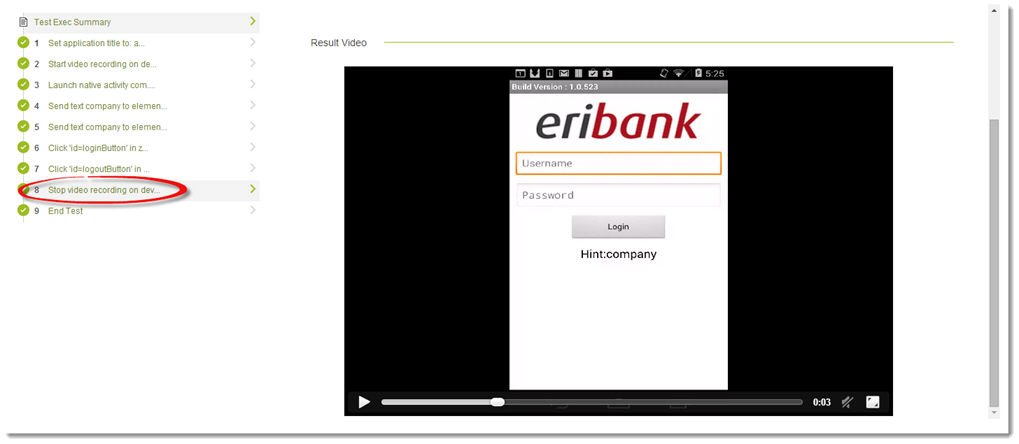
Note: There is no limitations on the number of different videos that can be generated during a single script. You can add the StartVideoRecord / StopVideoRecord commands multiple times during a script, and for each block the video will show in the report under the proper StopVideoRecord command.
Code Examples
client.startVideoRecord();client.stopVideoRecord();client.StartVideoRecord();client.StopVideoRecord();client.StartVideoRecord Reportclient.StopVideoRecord Reportself.client.startVideoRecord()self.client.stopVideoRecord()$client->startVideoRecord();$client->stopVideoRecord();
The following properties of file app.properties can affect the quality and the duration of the recorded video:
-
VideoBuilder.timeScalePerSecond=<FPS>
which sets how many frames are to be taken per second, i.e., the quality of the video. By default, the quality is four frames per second. For example, in order to set the video quality to 7 frames per second, you can add the following entry to file app.properties:
VideoBuilder.timeScalePerSecond=7 -
VideoBuilder.videoMaxSize=<SIZE_LIMIT_IN_BYTES>
which limits the size of the produced video file. The actual limit is slightly above <SIZE_LIMIT_IN_BYTES> bytes. For example, in order to limit the recorded video by approximately 1GB, you can add the following entry to file app.properties:
VideoBuilder.videoMaxSize=1000000000
When this property is not set, the video-file size is limited by nearly 100MB.
It is not recommended to set this value to a small number.